



Share this article


Engineered for Fire Safety: 2D Shuttle Storage for a Class 4 Commodity Operation
When Worley engaged Platform 1 on behalf of Orion Engineered Carbons (OEC), the project parameters were clear from the outset: automated high-density storage for a facility handling carbon black, a Class 4 combustible commodity that imposes fire safety requirements most warehouse storage systems are never designed to meet.
Carbon black production creates a storage challenge that goes well beyond tonnage and throughput. Class 4 classification means the material is highly flammable, and any automated storage system must be engineered with fire suppression built directly into its structure, not retrofitted around it. Fire baffles, in-rack sprinklers, and multi-discipline coordination aren’t optional features on a project like this. They’re the design brief.
Platform 1 delivered a 2D shuttle system that met all of those requirements, drawing on the Constructor global manufacturing network to source precision-engineered components across three continents and commissioning the complete system in February 2026.
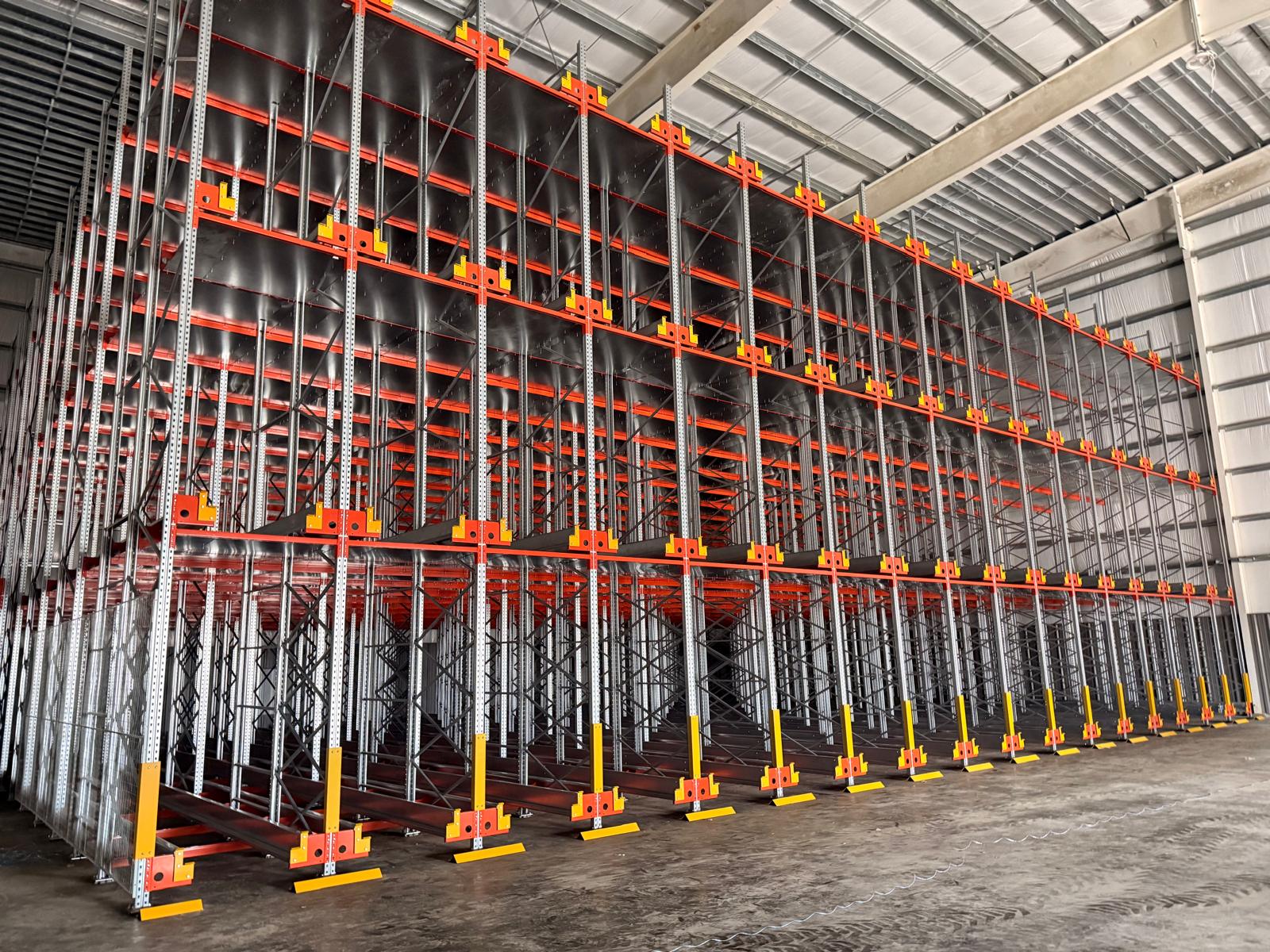
The result is a state-of-the-art clad rack facility: 22.97 metres high, 996 pallet positions across 13 storage levels, all within a total footprint of just 3,620 square metres. It’s a system engineered for density, precision, and operational durability.
The Challenge: Storing a Combustible Commodity at Scale
Orion Engineered Carbons is one of the world’s leading producers of carbon black that is a material used across the rubber, coatings, and plastics industries. Carbon black’s combustibility places it in Class 4 under standard commodity classification frameworks, which means that any automated storage system handling it must satisfy fire engineering requirements that go significantly beyond those of a conventional warehousing project.
The fire safety requirements drove the scope on multiple fronts: fire baffles had to be incorporated into the racking structure to compartmentalise the storage zone and limit fire spread; in-rack sprinklers had to be integrated within the rack itself rather than mounted overhead only; and the sprinkler design had to be coordinated with the mechanical requirements of the 2D shuttle system, ensuring coverage without obstructing shuttle travel paths. This required active coordination across multiple design disciplines: structural, mechanical, fire engineering, and building services all working in parallel throughout the project.
The system also needed to accommodate multiple pallet sizes and materials, including different pallet types within a single storage lane. For high-throughput commodity operations, that flexibility is operationally essential, but it adds meaningful engineering complexity to an already demanding scope.
When the commodity is Class 4 combustible, fire safety isn’t an afterthought, it’s the design constraint everything else is engineered around.
The Solution: A 2D Shuttle System Built Around the Commodity
Platform 1 specified a 2D shuttle system that is an automated, high-density storage technology in which shuttle carts operate on two axes within the racking structure, moving pallets efficiently across all lanes without manual handling. Unlike a conventional single-depth shuttle, the 2D configuration delivers both high storage density and retrieval flexibility: any pallet in the system is accessible without needing to remove pallets stored in front of it.
The critical engineering work was integrating fire safety directly into the structural design rather than treating it as a separate discipline. Fire baffles were incorporated into the racking to divide the storage volume into defined compartments, limiting the spread of any ignition event within a high-density automated environment. In-rack sprinklers were positioned within the rack structure itself, placed in coordination with the shuttle’s travel geometry to maintain full fire suppression coverage without interfering with automated pallet handling. Both systems were engineered as part of the rack design, not added on after the fact.
Multi-pallet capability was achieved through the system’s lane configuration, allowing different pallet sizes and materials to coexist within a single storage lane. This flexibility is particularly valuable in a commodity operation where packaging and pallet specifications can vary across product lines and supply sources.
The supply chain was coordinated through the Constructor global manufacturing network, drawing on Dexion manufacturing facilities in Romania and Germany, Automha automation components, and Gonvarri fabrication in Colombia. For a North American operation, this level of supply chain access, purpose-built components from precision manufacturers across three continents, coordinated under a single project structure is not something a local racking supplier can replicate. It is the direct result of Platform 1’s partnership with Constructor, the global industrial storage engineering group.
Results: Capacity, Speed, and Safety All Improved
The system was commissioned in February 2026 approximately 13 months from the original purchase order. For a project of this complexity Class 4 commodity requirements, integrated in-rack fire suppression, multi-continent supply chain, multi-pallet configuration, and coordination across multiple engineering disciplines and on-time delivery is not a given. It reflects tight project management and a supply chain that could execute at the precision the project demanded.
The completed installation gives Orion Engineered Carbons a high-density automated storage system purpose-built for their commodity. Manual handling in a carbon black environment carries real operational and safety risk; the 2D shuttle system removes that exposure while improving throughput consistency and reducing the human error that manual operations introduce at scale.
The integrated fire safety system baffles and in-rack sprinklers engineered into the rack structure meets the requirements of Class 4 storage at a structural level rather than relying solely on overhead suppression. That distinction matters in an automated environment: fire safety that is built into the system performs more reliably than fire safety that sits around it.
When the commodity adds complexity, the storage system has to absorb it. Class 4 classification, fire suppression integration, multi-pallet requirements, and international supply chain coordination are not edge cases for Platform 1 — they are the kinds of engineering challenges the Constructor partnership was built to solve.
Ready to explore automated storage for your facility? Contact us today to discover storage solutions engineered for your business.
Share this article