Automotive logistics operations don’t have room for inefficiency. When a leading automotive manufacturer needed to significantly increase storage capacity without expanding their building footprint, the answer was to go vertical — and to make that vertical storage fully automated.
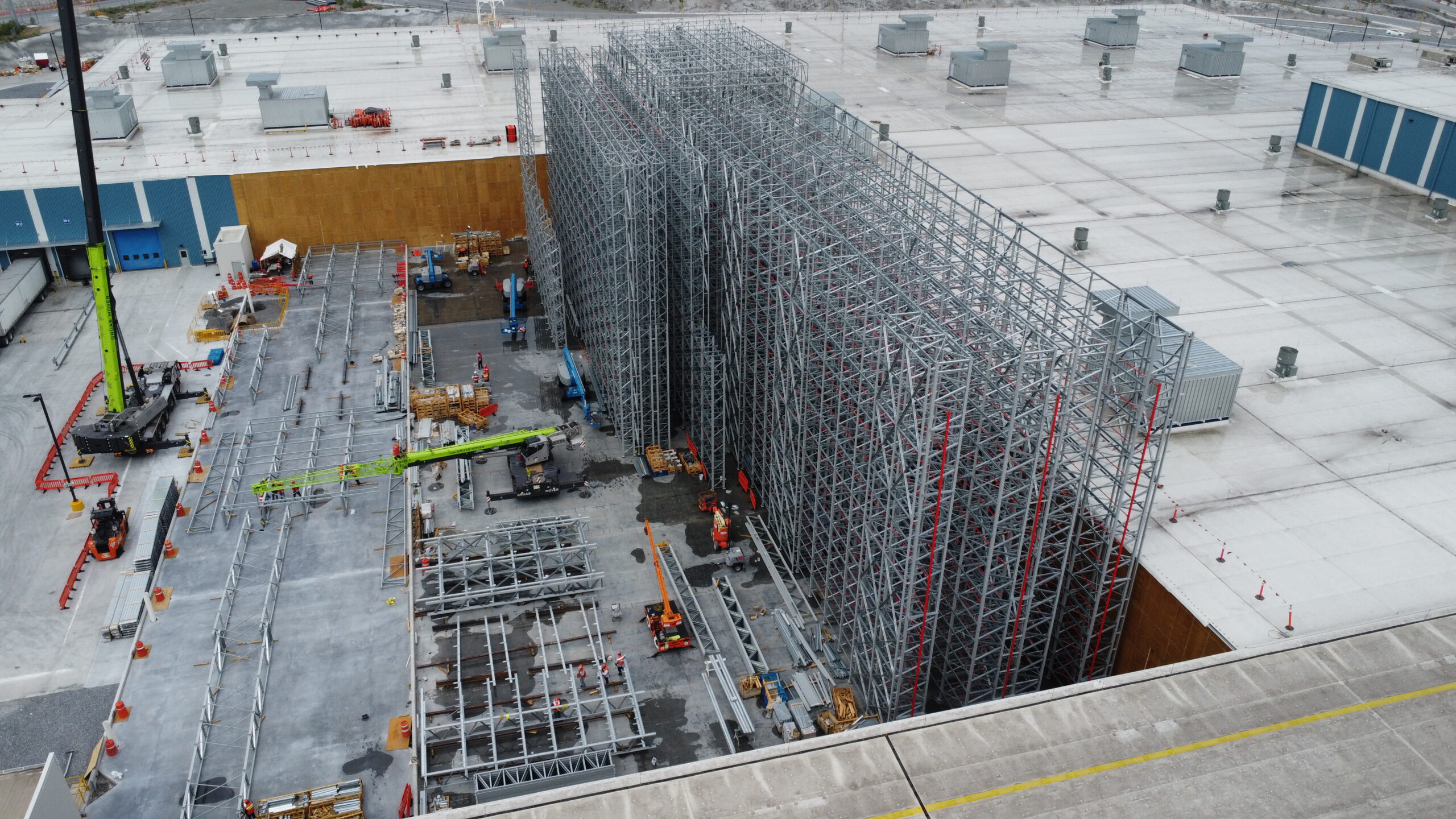
The result is a state-of-the-art clad rack facility: 22.97 metres high, 8,708 pallet positions across 13 storage levels, all within a total footprint of just 3,620 square metres. It’s a system engineered for density, precision, and operational durability.
Engineering for Density Without Compromise
A clad rack system — where the racking structure itself forms the building shell — is the most efficient way to maximise vertical storage. Rather than constructing a conventional building and fitting racking inside it, the racking IS the building. This approach eliminates wasted space between the structural envelope and the storage system, achieving pallet density that conventional warehousing simply cannot match.
For this project, the engineering team designed a system achieving 4.47 square feet (0.415 square metres) of floor area per pallet — an exceptionally tight density figure that reflects how thoroughly the available volume was utilised. Top hats and rails guide the automated cranes for precise pallet handling, while horizontal and vertical baffles provide enhanced fire safety throughout the structure.
Building Automation Into the Structure
The implementation was structured in four phases: engineering and design, construction and assembly, automation integration, and testing and optimisation. Each phase was executed sequentially to maintain safety and precision, with the automation layer — AS/RS cranes, conveyor systems, and warehouse management software — integrated once the structural framework was complete.
One of the key engineering challenges was maintaining structural integrity while constructing a high-rise racking system. The team used reinforced materials and innovative design strategies to ensure stability across the full height of the structure. Coordination with the client’s logistics and automation teams ran in parallel throughout, ensuring seamless integration with existing supply chain workflows.
A phased deployment approach was used for the transition to full operation, allowing the facility to come online progressively with minimal disruption to the surrounding logistics operation.
Results: Capacity, Speed, and Safety All Improved
Upon completion, the facility delivered on every major operational metric. Storage capacity increased significantly within the same physical footprint. Automated handling reduced manual intervention throughout the pallet cycle, improving throughput speed and consistency. Advanced structural reinforcement and automation reduced the manual handling risks that had previously existed in the operation.
The streamlined supply chain logistics — with pallets moving through an integrated conveyor and crane network rather than relying on manual forklift operations — this improved the predictability and speed of the entire storage and retrieval process.
If your facility faces similar constraints — growing inventory volumes, limited floor space, and pressure to maintain throughput — clad rack automation may be the solution worth evaluating.
Ready to explore clad rack automation for your facility? Contact us today to discover storage solutions engineered for your business.